Can Foreign Companies Reclaim Japan Consumption Tax Paid at Import?
Disclaimer
This article is provided for general informational purposes only and does not constitute tax, legal, or accounting advice. Japan Consumption Tax treatment can vary depending on a company’s structure, transactions, registration status, and specific circumstances. Companies should seek advice from a qualified tax professional before making decisions based on the information in this article.
Japan Consumption Tax (JCT) paid at import can, in some cases, be recovered by an overseas company selling in Japan. However, obtaining a JCT number does not mean the full amount paid at customs will automatically be refunded.
Japan Consumption Tax (JCT) applies to most goods and services supplied in Japan and to goods imported into the country. For companies importing inventory and selling it domestically, JCT can arise at two points within the operating cycle: first when products enter Japan, and later when they are sold to customers.
These are separate taxable events, but they are brought together through the company’s year-end JCT filing and adjustment process. Eligible import JCT and qualifying business input tax are assessed alongside the JCT associated with domestic sales, and the final result may be a refund, a zero balance, or additional tax due. Understanding this full cycle is essential before deciding whether to register.
What is Japan Consumption Tax (JCT), and what does a JCT number change?
Japan Consumption Tax (消費税) is similar to VAT or sales tax in other markets. The standard rate is 10%, while a reduced 8% rate applies to certain goods and transactions. When products are imported into Japan, the applicable JCT must be paid upfront at customs before the shipment is released.
For companies importing regularly into Japan, this can become an important part of their financial planning. The tax is paid when the inventory enters the country, even if some products are later discounted, returned, damaged, or remain unsold. For this reason, some companies choose to register for a JCT number so they can account for eligible tax paid through a later tax adjustment process rather than treating the full amount paid at import as a fixed cost.
For B2B sales, there is a separate consideration. Under Japan’s Qualified Invoice System, Japanese business customers generally need a Qualified Invoice to claim the related input consumption tax credit. Being a JCT taxable business does not automatically make a company a Qualified Invoice Issuer. A separate application is required, and once approved, the NTA issues a registration number beginning with the letter T, followed by the company’s 13-digit Corporate Number or another assigned number where applicable.
For example: T1234567890123
Once a company becomes subject to JCT, it must file for each applicable tax period and report the taxable sales and eligible input tax relevant to that period. Supporting records must also be maintained. The effective date of its taxable status matters because it determines which transactions can be included in the JCT filing and adjustment process.
Companies can register for a JCT number voluntarily, while others may become required to do so based on their taxable sales and applicable taxable period. The JPY 10 million threshold is generally assessed using an earlier base period, so the obligation does not begin immediately when current-year sales exceed that amount.
Read more: Understanding the Japan Consumption Tax (JCT) – Should you Get One?
Registration timing is only one part of the decision. Having a JCT Number does not mean that the JCT paid at customs will automatically be refunded. Registration provides access to the filing and adjustment framework, but the final result depends on the company’s actual imports, sales, qualifying expenses, adjustments, and supporting records during the taxable period.
How does JCT work without a Japanese entity?
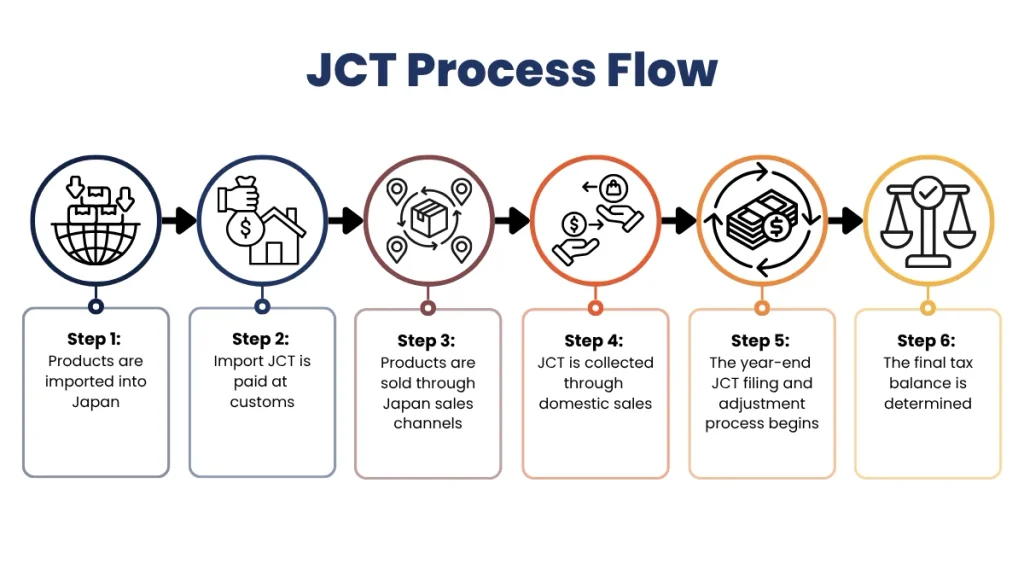
Step 1: Products are imported into Japan
The overseas company first establishes the correct importer structure. Before shipment, it should be clear who is acting as the importer, who will appear on the customs declaration, and how the import documentation will connect to the company’s later tax filing.
The importer may be:
- A Japanese company
- A Japanese subsidiary of an international company
- An eligible non-resident importer using an ACP structure
A customs broker can submit the import declaration on the importer’s behalf, but this does not automatically make the broker the importer. The importer named in the customs documentation should reflect the actual import transaction and commercial structure being used.
This matters because the importer structure affects whose name appears on the customs records and who may be able to include the import JCT in a later tax filing.
Step 2: Import JCT is paid at customs
When the products enter Japan, import JCT is assessed during customs clearance. The applicable tax is paid before the goods are released, together with any customs duty or other charges that apply.
How the customs value is determined depends on the import structure:
- Japanese importer purchasing from an overseas seller: The customs value is generally based on the transaction price, with freight, insurance, and other applicable costs added. This is commonly understood as the CIF-based value.
- Non-resident importer bringing its own inventory into Japan for later sale: Where there is no qualifying import transaction, Customs may use an alternative valuation method based on the expected domestic selling price before JCT, with permitted deductions for items such as normal profit, selling expenses, domestic transportation, customs duties, and other Japanese taxes.
The Import Permit Notification becomes a key record at this stage because it identifies the importer and records the import tax assessment. If the overseas company later wants the import JCT considered in its own filing, the importer details and supporting customs records need to support that position.
Step 3: Products are sold through Japan sales channels
Once the products have cleared customs and completed any category-specific requirements, they can be sold through channels such as Amazon Japan, Rakuten Ichiba, retail, B2B, or the company’s own eCommerce store.
The overseas company records the sales that fall within its Japanese tax position. This generally includes domestic transactions where the company is selling inventory already imported into Japan.
A separate cross-border sale where the Japanese buyer acts as importer may follow a different tax treatment, so the sales structure should be reviewed according to who is selling, who is importing, where the goods are located at the time of sale, and how the customer is invoiced.
Step 4: JCT is collected through domestic sales
When taxable products are sold in Japan, the seller collects JCT from the customer as part of the sales price and records that amount for the later tax adjustment.
The company should retain sales records throughout the year, including:
- Sales invoices
- Amazon Japan, Rakuten Ichiba, or other marketplace reports
- Qualified invoices where applicable
- Returns and refunds
- Discounts and other sales adjustments
For B2B transactions, a qualified invoice may be required if the Japanese customer needs to support its own input consumption tax credit.
This stage is important because the JCT collected through domestic sales will later be compared with eligible JCT already paid on imports and qualifying business expenses.
Step 5: The year-end JCT filing and adjustment process begins
At the end of the fiscal year, the company brings together its sales, import, and expense records to calculate its JCT position. For corporations, the consumption tax return is generally due within two months after the end of the taxable period.
At a simplified level, the calculation compares the JCT associated with domestic sales against eligible JCT already paid on imports and qualifying Japan-side business expenses:
Output tax liability – (eligible import JCT + eligible JCT paid to Japanese vendors) = final JCT adjustment
Eligible input tax can include more than JCT paid at customs. It may also include JCT paid to Japan-based providers that support the company’s operations, such as 3PL providers, Amazon Japan, marketing agencies, or other local vendors.
For these expenses to be considered, the company must keep the required supporting records. In general, the Japanese provider also needs to be registered under the Qualified Invoice System and issue a qualified invoice.
Foreign companies should therefore maintain records such as:
- Import Permit Notifications supporting eligible import JCT
- Domestic sales invoices and marketplace reports
- Qualified invoices from eligible Japanese vendors
- Records of refunds, returns, and other adjustments
Step 6: The final tax balance is determined
Once the JCT return has been completed, the company’s final tax position is confirmed. The result may be:
- A refund
- A zero balance
- Additional JCT payable
For a foreign company using a Japan-based tax representative, the representative handles the settlement process on the company’s behalf.
If a refund is due, it is received through the agreed Japan-side representative structure and then remitted to the foreign company. If additional JCT is payable, the amount is communicated to the foreign company, collected, and paid to the tax office on its behalf.
JCT can have a direct impact on the cost of importing, operating, and selling in Japan.
For overseas companies, the key is understanding how their import model connects with their tax obligations and making sure the required structure is in place before those obligations begin to affect the business.
COVUE can act as your tax representative in Japan and support JCT registration, ongoing tax procedures, and coordination throughout the filing process. As your business develops, we work alongside your operations to keep the fiscal requirements connected to your actual import and revenue in the market.