
Choosing the Right Model: Four Viable Paths to Japan Market Entry
For international brands, entering Japan is often framed as a question of who to sell to, whether directly to consumers, through retailers, or through a distributor.
This focus on sales channels can overlook a more important decision: how the business will operate once it enters the market. The chosen model affects how much the company invests, how much control it retains, and who takes responsibility for local execution. COVUE generally sees four viable paths. The right starting point depends on the company’s current readiness and its longer-term ambitions for Japan.
What Should a Brand Consider Before Choosing a Japan Entry Model?
Before choosing a particular route, a brand should assess five connected questions.
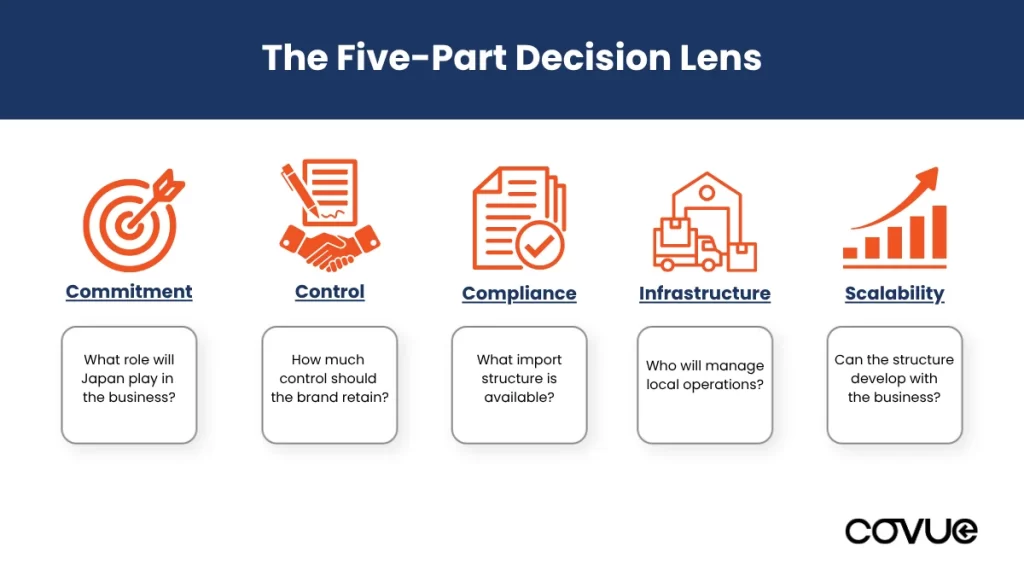
1. What role will Japan play in the business?
The company should first define whether Japan is an early market test, a developing growth opportunity, or a long-term strategic market. This will influence the level of investment and local capability it should build from the outset.
2. How much control should the brand retain?
The brand should decide how directly it wants to manage its pricing, positioning, customer relationships, and sales channels. Retaining more control usually requires greater internal ownership or stronger Japan-side support.
3. What import structure is available?
The product category and intended claims can affect which import and compliance structures are available. These requirements should be reviewed before the brand commits to a sales channel or local partner.
4. Who will manage local operations?
A workable model needs clear ownership across the import process and day-to-day customer delivery. The responsible parties should be agreed before launch so that gaps do not emerge between the brand, its commercial partners, and its service providers.
5. Can the structure develop with the business?
The initial model should support the first stage of entry without limiting future expansion. Brands should consider whether it can accommodate higher volumes, additional channels, or a later move to a more established Japan operation.
A strong Japan entry model matches the company’s ambitions with its current readiness. The easiest route to launch is not always the best structure for dependable service or long-term growth.
What Are the Four Main Paths to Japan Market Entry?
International brands can enter Japan through several operating structures. Each requires a different level of investment and gives the brand a different degree of control over local operations. The four paths below represent the models COVUE encounters most often.
Entry Path 1: Cross-border D2C
Cross-border direct-to-consumer (D2C) sales allow a brand to serve Japanese customers while keeping inventory and most of its operations outside Japan. This can reduce the initial setup required and provide a practical way to observe early demand before investing in local infrastructure.
The model works best when Japanese customers still receive a reliable buying experience. Korean cosmetics brands provide a useful example. Many sell into Japan through Amazon Japan, Qoo10, or their own eCommerce websites while using fast shipping from Korea, localized content and accessible customer support.
Cross-border selling does not create the same Japan-side compliance obligations for most product categories. However, specific requirements may still apply to certain electrical products and toys intended for children under three. Marketplace rules should also be checked separately before launch.
Commercial success also depends on whether the buying experience meets local expectations. Brands using cross-border D2C should provide properly localized product information and accessible customer support.
Cross-border D2C can provide useful demand signals, but slower delivery, difficult returns, or limited support may affect performance. It is therefore most useful as an early testing route rather than a complete long-term operating model.
Entry Path 2: Local Partner Model
A local partner can provide Japan-side infrastructure without requiring the brand to establish its own Japanese entity. The scope may include import support, compliance, logistics, marketplace operations, localization, or customer care.
One structure available to eligible non-resident importers is the Attorney for Customs Procedures (ACP). The ACP supports the overseas importer with customs procedures in Japan.
This route can suit brands that want a more established operating structure while retaining control over pricing, positioning, and sales channels.
An olive oil brand supported by COVUE used this model after struggling to secure distributor interest after participating in trade shows. The company launched on Amazon Japan, built early market awareness, and later returned to distributor and retail discussions with stronger demand signals.
Read more: How COVUE helped a Premium Food Brand Validate Demand in Japan
The model depends on a clear allocation of responsibilities. The brand and its partner should agree who manages each part of the Japan operation before launch.
When defined properly, a local partner model can offer a balanced route for brands that need local execution but are not ready to establish a Japanese entity.
Entry Path 3: Distributor or Wholesale Model
A distributor or wholesale partner can provide access to established buyers and existing sales channels in Japan. This may reduce the time needed to build a local sales network, particularly when the partner already understands the product category.
The tradeoff is reduced visibility into how the partner represents the product and how customers respond to it. Distributor margins affect the commercial model, while dependence on one partner can limit future options. Some distributors may also want evidence of demand in Japan before committing resources.
A successful agreement should therefore define the partner’s role beyond sales targets. It should identify who controls the import and regulatory process. Expectations for inventory visibility, reporting, and customer support should also be agreed before launch.
For a food brand COVUE previously worked with, the distributor expanded physical retail reach while the brand retained control over Japan marketing. Clear reporting expectations helped protect its positioning despite limited visibility into individual retail locations. Distribution can create valuable reach, but the relationship still requires active governance. Brands should assess how accountability and channel control will be maintained before committing to the model.
Entry Path 4: Establishing a Japan Entity
Establishing a Japanese entity gives a brand the highest level of local ownership and control. It allows the company to build its own team, manage local relationships directly, and develop operations around its long-term priorities.
Because the process requires significant time and resources, this route generally suits brands that have already validated demand and confirmed Japan as a strategic market. Incorporation is only the first step. The company may also need to build the staffing, premises, systems, and licenses required for its specific activities.
One global OEM initially entered Japan with COVUE as its local IOR partner. After reaching approximately JPY 5 billion in annual Japan revenue, it moved to its own licensed operation to gain greater control over regulated activities.
Read more: From IOR to In-House Operations: Building Licensed Japan Infrastructure for a Global Medical Device and Cosmetics Company
How Do the Four Japan Market Entry Models Compare?
The comparison below provides a high-level view of where each path can fit, what it offers, and where brands should expect tradeoffs.
| Entry model | Best suited to | Initial commitment | Brand control | Local infrastructure | Main advantages | Main limitations |
| Cross-border D2C | Brands testing early demand before building structure | Low | High | Low | Lower initial setup, direct brand control, and faster early learning | Longer delivery and return process may weaken the customer experience |
| Local partner model | Brands wanting Japan-side operations without establishing their own entity | Medium | Medium to high | Medium to high | Local import and operational support while retaining control over branding, pricing, and channels | Requires clearly assigned responsibilities, documented processes, and a realistic operating budget |
| Distributor or wholesale model | Brands prioritizing local reach, buyer relationships, and sales execution | Medium | Low to medium | Mainly provided by the partner | Access to established retail, wholesale, or B2B networks and local commercial knowledge | Reduced visibility, lower control, distributor margins, and possible dependence on one partner |
| Japan entity | Brands with validated demand and a long-term strategic commitment to Japan | High | High | High | Direct ownership of local operations, teams, channels, customer relationships, and governance | Higher cost, staffing needs, admin, licensing requirements, and ongoing management responsibility |
These models should be compared according to fit rather than treated as a ranking. A lower-commitment route may suit early validation, while a more developed structure may become appropriate as demand and local responsibilities increase. The right choice depends on the company’s current stage and its ambitions for Japan.
Entry Models Can Change as the Business Develops
A brand’s first entry model does not need to remain permanent. The structure may change as sales increase, local responsibilities develop, or the company decides to invest more deeply in Japan.
For example, a company may begin with cross-border D2C and later move to a local operating structure that supports commercial imports and domestic inventory. Another may begin with a distributor and establish its own entity once the market justifies direct ownership.
Companies should review their operating model when making changes to legal presence or importer arrangements.The goal is to choose a valid structure for the company’s current stage while understanding what may need to change as its Japan business develops.
How COVUE Can Help You Choose the Right Starting Point
Choosing the right market entry structure requires understanding what the product needs, what the company is ready to manage, and how its plans for Japan may develop. COVUE helps brands assess these factors together and identify a compliant starting point that can develop with the business.
Define Your Japan Entry Strategy with COVUE
Entering Japan requires choosing the right compliance and operational structure from the start. The best approach depends on your product type, regulatory requirements, and whether you need an ACP or a local entity.
Speak with our team to identify the most practical and compliant starting point for your brand in Japan.