Importing Electronics to Japan? Here’s All You Need to Know!
In 2022, the eCommerce penetration rate in Japan’s home appliance market reached an impressive 42.01%.
Fast forward to 2024, the domestic shipment value of home appliances has increased by 1.2% compared to the previous year. This growth is largely driven by rising wages and the growing demand for high-end home appliances among inbound foreign tourists, which is expected to boost the market even further.
As the market expands, so does the need for stricter regulations, especially with the increase in faulty products from overseas.
Japan enforces two key regulations for appliances. Products with an AC adapter must comply with PSE regulations, while those using radio waves are governed by the Radio Law. However, some importers have managed to bypass these requirements.
One concerning incident occurred in Chiba Prefecture, where a fire was sparked by a mobile battery purchased online from an overseas manufacturer. The fire damaged the home’s floor, walls, and bed.
To address issues like this, the Ministry of Economy, Trade and Industry (METI) began “Internet Patrols” in 2020, focusing on ensuring that sellers — especially on eCommerce — comply with display standards, further strengthening the regulation.
As a result, from December 25, 2025, foreign sellers of regulated product safety goods will no longer be able to rely on simple cross-border drop-shipping into Japan. Instead, they will need a proper compliance structure, including filing a notification with METI as a Specified Import Business Operator, assuming product safety responsibility in the Japanese market, and appointing a Domestic Administrator to serve as the local point of contact for compliance, reporting, and regulatory communication.
Use this article as a guideline to ensure your product enters the Japanese market safely and legally!
Electrical Appliances and Materials Safety Act (The PSE Law)
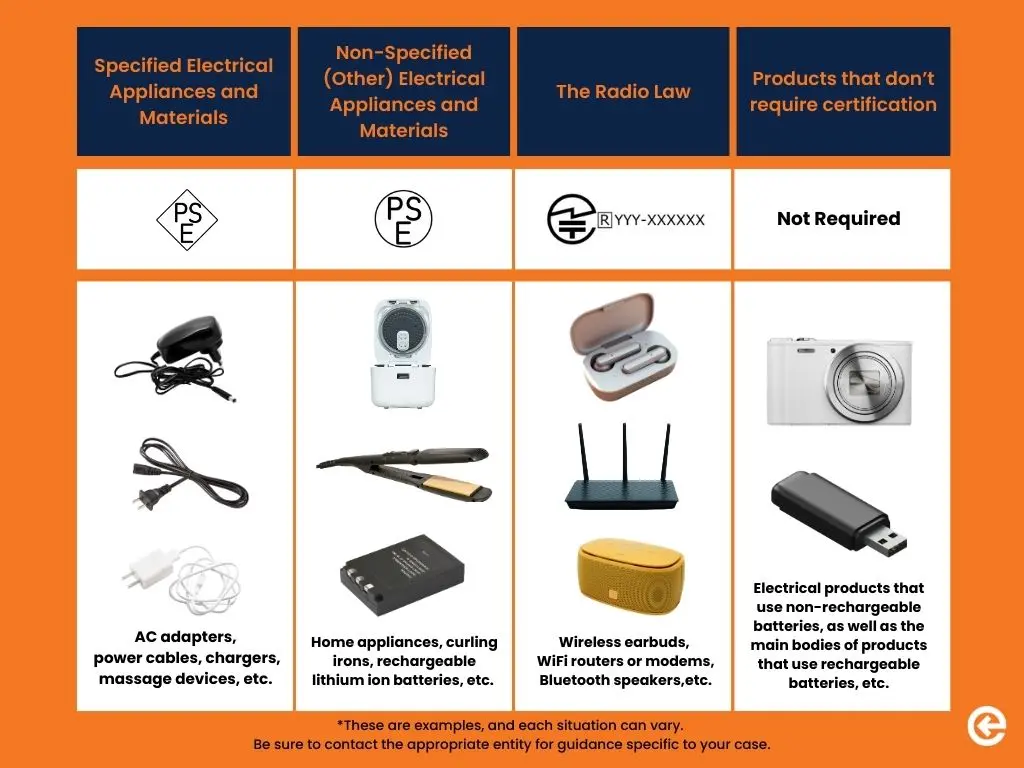
457 types of electronic products are governed by Electrical Appliances and Materials Safety Act or the PSE law.
Under this law, electrical products are divided into two risk-based categories:
- Specified electronic products, subject to a Registered Conformity Assessment Body compliance evaluation. You will need a copy of the original equivalent certificate issued after testing by a METI-registered inspection body.
- Non-specified products, following a self-declaration process
Regardless of whether the electrical product is classified as specified or non-specified, a self-inspection of every unit is always required.
Here are examples of products that are subject to the PSE law:
- Electrical appliances that come with AC adapters
- Mobile batteries with an energy density of 400Wh/L or higher
- Lithium-ion batteries with an energy density of 400Wh/L or more
*Note: Even if a device like a computer has a built-in lithium-ion battery, it is exempt from regulation if the user cannot remove the battery.
Products must comply with this standard to be sold in Japan. The certification process involves testing for electrical safety, electromagnetic compatibility, and other safety requirements. The PSE mark is mandatory for importers who want to sell their electronic products in Japan.
PSE marks show that product safety has been confirmed by the business operator responsible for placing the product on the Japanese market.
Traditionally, foreign brands without a local entity needed a Japanese company to handle both import and PSE compliance. In this model, the same company acted as the ACP and the METI notifier. This meant the local partner imported the product, completed the PSE procedures, appeared on the labeling, and assumed product safety responsibility in Japan.
Under the Domestic Administrator model, these roles can now be separated. Foreign brands still need an ACP when importing products into Japan, but they can choose to remain market responsible as the Specified Import Business Operator. In this structure, the foreign seller acts as an importer and handles product safety compliance, while the Domestic Administrator supports Japan-side communication, reporting, and regulatory administration as METI’s local point of contact.For direct-to-consumer drop-shipping, the seller still carries product safety responsibility and must complete the required compliance steps before selling, including testing, labeling, notification, and appointing a Domestic Administrator. An ACP is not required in this model because the Japanese consumer is treated as the importer, but the consumer does not become responsible for market safety.
Japan Radio Law
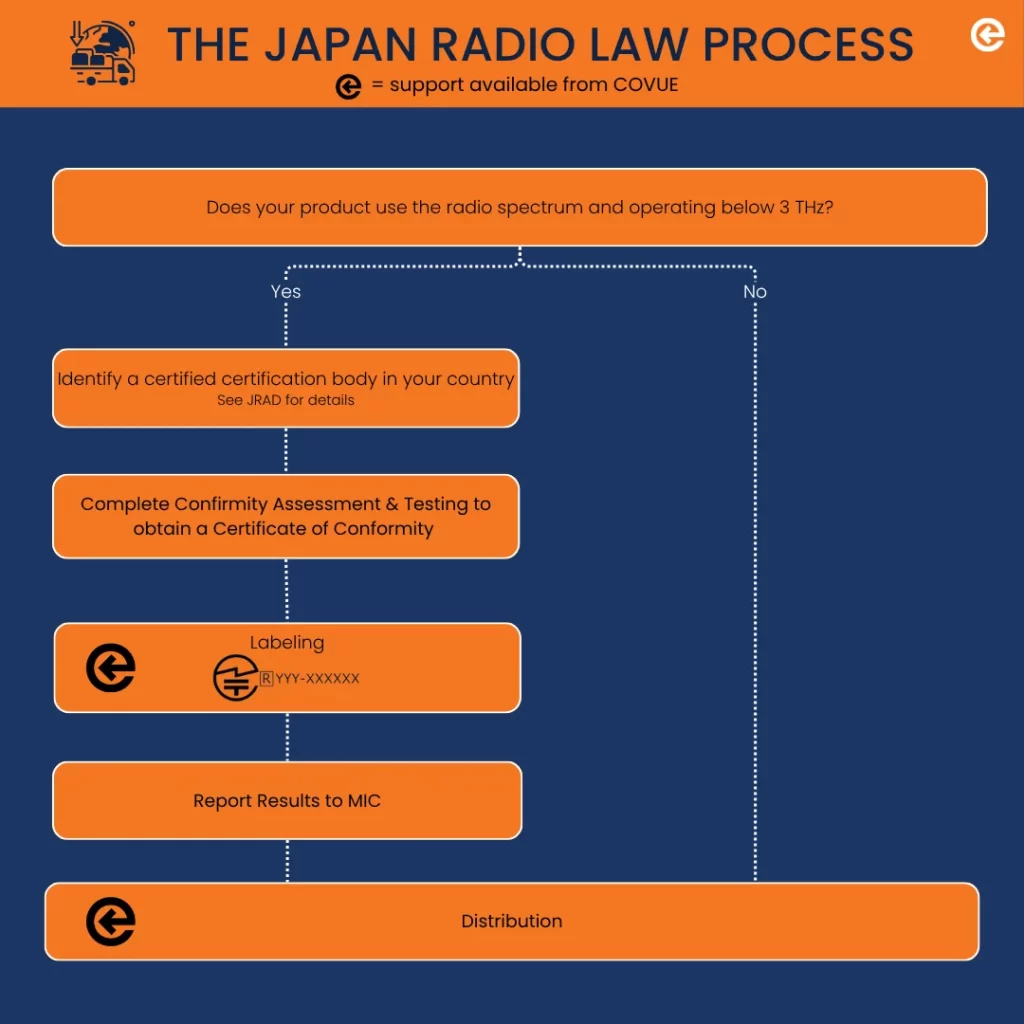
The Japan Radio Law applies to all products that use the radio spectrum and operate below 3 THz.
This can include items that aren’t typically considered radio communication devices, like discharge lamps or induction heating equipment. Just having a PSE mark may not be enough to bring these products into the Japanese market.
Specified Radio Equipment, such as Bluetooth and WiFi, and High-Frequency Devices, including most ISM devices like microwaves, wireless headphones, ultrasonic devices, etc., must go through mandatory approval processes.
Get Ready for Your Import – What You Need
Step 1: Choose an Attorney for Customs Procedure & Importer of Record
Finding a reliable individual or company to support you as an Attorney for Customs Procedure (ACP) with experience importing electronic products into Japan is crucial. Your local partner should thoroughly understand Japanese regulations to ensure a smooth and successful import process. Remember, if you’re a non-resident importer, you need a Japanese entity to handle the PSE process.
Step 2: Determine What Certification Your Product Needs
Check if the Electrical Appliance and Material Safety Law applies. Determine the type of classification your product falls under. If you work with a Japanese importer, they can make sure your product can be imported under the Japanese compliance laws.
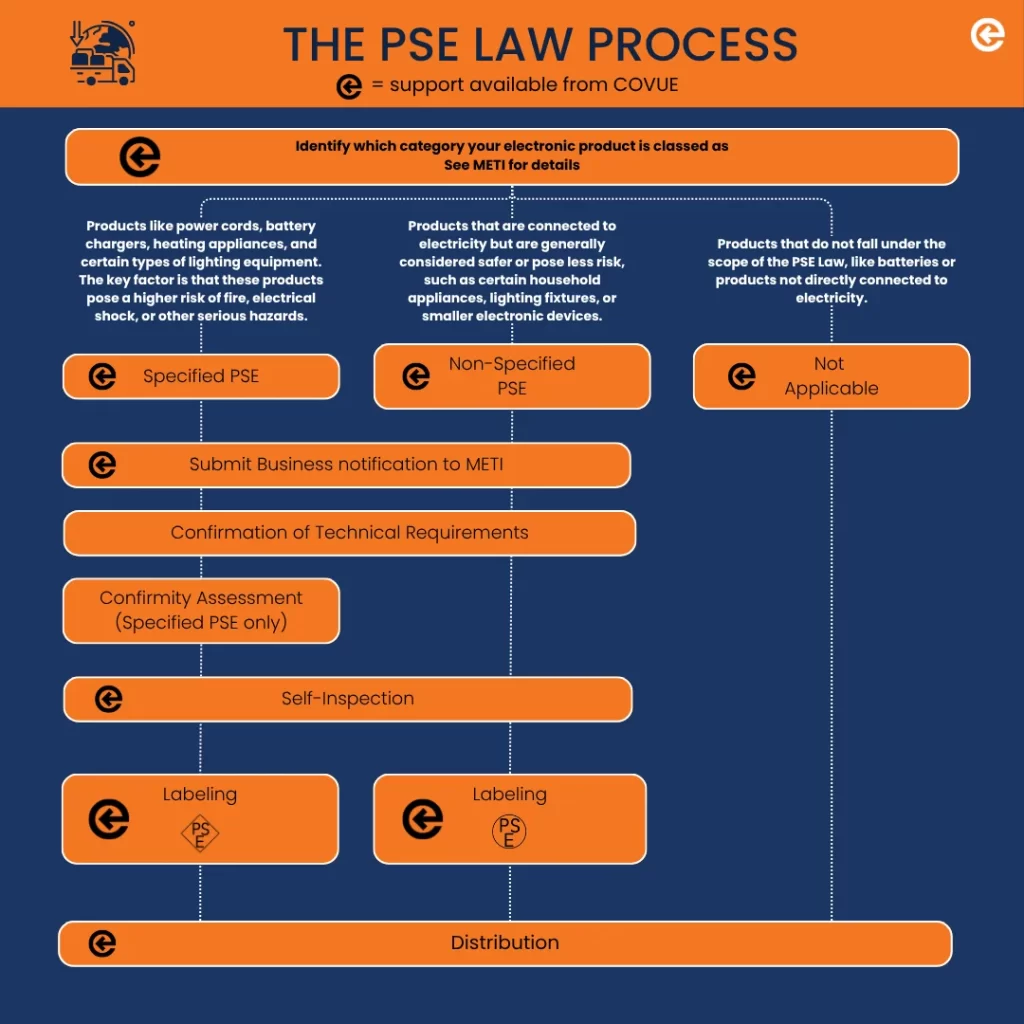
Step 3: If It’s a PSE Product
If your product falls under the PSE law, submit a notification of business to METI. Confirm the technical requirements.
If your product is regulated as a specified product, it has to go through conformity assessment. If not, you can skip this step. After the product goes through a self-confirmation test, it can be labeled and shipped.
With a partner in Japan, you can register your product with them, submit the PSE testing result to them, and they will submit it to METI. Alternatively, you can appoint a Domestic Administrator in Japan and preserve product safety responsibility as the overseas seller.
Key Notes:
- Importers need to notify METI within 30 days from commencement of the business. The notification requirement follows the party taking responsibility for the product in Japan, whether that role is held overseas or by a domestic operator. Keep in mind that the commencement date refers to when Electrical Appliances and Materials were either manufactured (completed) or imported into Japan.
However, it could also be the date when business preparations were made or when an internal decision was made to start the business. - Manufacturers are responsible for ensuring their products meet technical standards by conducting PSE compliance testing.
- For specified products: Overseas manufacturers are required to obtain an equivalent certificate from a Registered Conformity Assessment Body.
- For non-specified products: While obtaining an equivalent certificate from a Registered Conformity Assessment Body is not necessary, it is essential to verify compliance with technical standards.
Some local partners may request an equivalent certificate for technical conformity verification. There is no requirement to designate a specific inspection body.
- All products need to complete a self-inspection before import or upon arrival. There are no specific requirements regarding the location or the person conducting the self-inspection. As long as the necessary inspections are properly carried out, anyone can perform them, anywhere.
- Before shipping, all products must pass final compliance checks, and records of these checks should be kept for 3 years. Additionally, all relevant products must display the appropriate PSE mark before being sold.
Step 4: If It’s a Japan Radio Product
If your product is subject to the Japan Radio Law, you will submit an application to the Domestic Registered Certification Body or Registered Foreign Conformity Assessment Body.
Once your application has been confirmed, they will test your product if applicable. If not, they will assess your testing document instead. Once the specifications have been cleared, they will conduct a final review and issue a certification. You will receive a certification number and be required to put the certification mark on your product.
Key Notes:
- The Japan Radio Label must be affixed to the product before selling.
- The label must include the Importer of Record’s information, the Japan Radio Mark, and the license number.
- The label must be in Japanese.
How COVUE Can Help
Navigating the laws and regulations to import your electronic products can be challenging. At COVUE, we can serve as your Attorney for Customs Procedure(ACP) — sometimes referred to internationally as the Importer of Record (IOR) — in Japan, acting as your legal representative and supporting you through the entire registration process.
We offer end-to-end services to support your entry into the Japanese market. This includes taking advantage of our logistics and eCommerce services to ensure a smooth and successful launch in Japan.
Interested in learning more? Contact us today!
This article was originally posted on April 25, 2023, and updated with recent regulatory information on September 10, 2024 and July 27, 2026.