
What International Brands Need to Know About Shipping Products to Japan
Shipping to Japan requires more than choosing a carrier. Japan inbound logistics is closely connected to the commercial structure behind the shipment. Decisions about who imports the goods, who arranges transportation, and where the products go after clearance can affect cost, control, and lead time.
The process starts with the import model and continues through documentation, international transportation, customs clearance, and domestic delivery or fulfillment. At each stage, the structure affects how much responsibility the business carries and how much control it retains over cost and lead time.
How Your Japan Model Shapes Inbound Logistics
A cross-border seller, a brand working through an Attorney for Customs Procedures (ACP), a business selling to a distributor, and a company with its own local entity may all ship the same product to Japan, but the practical setup will likely look very different.
The first question is therefore who will act as the importer and how responsibilities will be divided between the parties involved. Where another party is involved, the agreed Incoterms are also an important part of that structure because they help determine who arranges transportation, where responsibility transfers, and how much control each party has over shipping costs and the movement of the goods.
Cross-border D2C
- Products are shipped from overseas directly to the end customer in Japan.
- The overseas seller typically arranges delivery to the customer.
- The seller controls the shipping method and customer delivery experience.
- Incoterms are commonly DAP or DDP, depending on whether the seller or customer is responsible for import duties and taxes. Under DAP, the customer may be responsible for duties and taxes at import, while under DDP the seller takes responsibility for those costs. DDP can offer a smoother customer experience by preventing unexpected charges or payment responsibilities at delivery.
- Striking a balance between delivery speed and cost is particularly important. International sellers compete with domestic businesses that can often fulfill orders within a few days, making sea freight less practical unless inventory is already positioned relatively close to Japan. Therefore, international courier and air freight options are often preferred.
ACP / Local Operating Partner
- The overseas business imports the cargo into the country as a non-resident importer with an ACP, which provides the Japan-side customs representation required for the import process.
- The exporter may need to manage different logistics providers if the ACP does not provide transport coordination services.
- The overseas business can retain considerable control over shipping methods and costs.
- Before export, ensure alignment with your logistics providers and ACP, especially on Incoterms, transportation needs, and delivery locations. DDP is commonly preferred in ACP arrangements, although the exact requirement depends on the provider.
Distributor-led Entry
- The Japanese buyer commonly takes the role of the importer.
- Who arranges the transportation and the place of delivery will depend on the agreed Incoterm. For sensitive shipments, such as frozen cargo, one of the parties may want to have more control over the shipping process.
- Inventory planning deserves particular attention. Distributor-led models often involve larger, planned movements of stock, which can make sea freight a convenient option when both parties have sufficient visibility over demand and replenishment needs.
Local Japanese Entity
- The company’s own Japanese entity can act as the local importer.
- The business can establish and manage its own transportation and Japan-side logistics arrangements.
- The company has greater control over the cargo import and inbound logistics process, but also takes greater responsibility in front of regulatory authorities.
- Documentation must accurately describe the goods, and customs value must be determined appropriately rather than using an arbitrary or nominal internal transfer value. If Japan Customs considers the declared value unsupported or too low, it may request additional documentation, reassess the customs value, and collect any additional duties and taxes due.
Read more: Choosing the Right Model: Four Viable Paths to Japan Market Entry
What to Confirm Before You Ship
Before the shipment departs for Japan, make sure that customs information is clear, including important details such as the consignee and final domestic delivery location.
Since October 12, 2025, Japan requires import declarations to include the name and address of the location where the goods will be delivered after import permission. For certain eCommerce shipments, the declaration must also identify whether the goods qualify as eCommerce cargo and include information about the relevant platform. For businesses, this means working to prevent inconsistencies between the declared import structure, shipment value, sales channel, and final destination, as these may be more visible to Customs and could result in additional scrutiny or delays during clearance.
You should also review the likely Japanese HS classification of the product before shipping. Japan Customs publishes its tariff schedules in English, which can be used to check classifications and corresponding duty rates, helping estimate whether customs duty may apply and how much it could add to the landed cost. These checks are useful for planning, but the classification applied at import is ultimately determined by Japan Customs.
Choosing the Shipping Method
Once your import structure is clear, you can choose how the goods will physically move to Japan. This decision should ultimately be about finding the right balance between delivery speed, cost, and your inventory strategy, within the constraints created by shipment size and weight and the requirements of your import model.
Businesses prioritizing fast delivery, small shipment volumes, or frequent replenishment will generally need to accept higher transportation costs in exchange for shorter lead times.
As volumes grow and demand becomes more predictable, cost-effective air transport or sea freight become more viable. Shipping by sea can significantly reduce transportation costs for larger shipments, but requires stronger forecasting and enough local inventory to cover demand during longer transit periods.
The import structure can also limit which options are available. For example, the ACP framework cannot be applied to postal imports, making EMS and other postal services unsuitable for models that require an ACP structure.
Shipping Method Comparison
| Shipping Method | Relative Speed | Relative Cost | Typical Fit |
| International courier | Fast | High | Small, urgent, or lower-volume commercial shipments |
| Air freight | Fast | High | Larger commercial shipments where lead time matters |
| Sea freight | Slow | Lower | Larger planned inventory movements and bulk replenishment |
| Postal services | Varies | Low to moderate | Small parcels where the import structure allows it. ACP cannot be used, making postal services unsuitable for fulfillment models such as Amazon Japan FBA. |
How Does Customs Work?
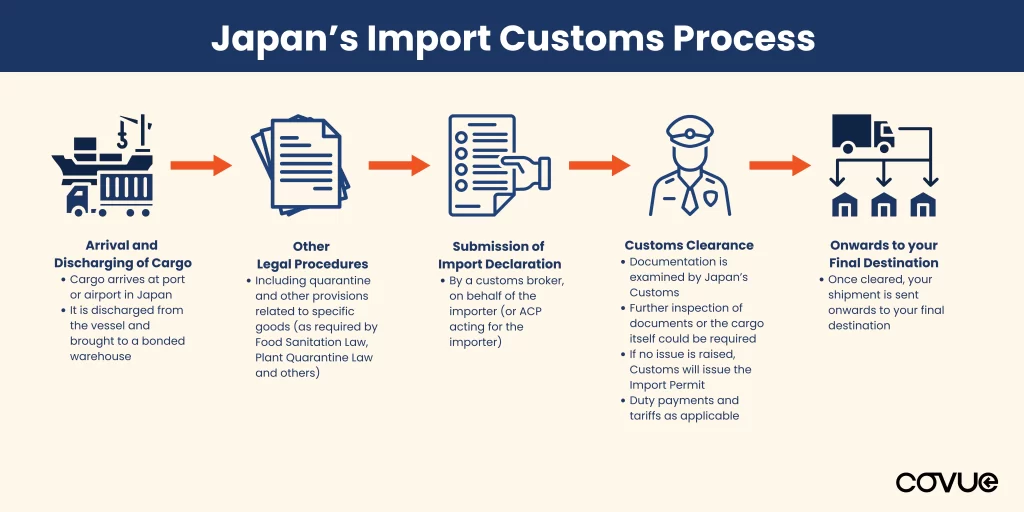
Once your cargo arrives at a Japanese port or airport, it normally remains under Customs control in a bonded area until the import procedures are completed.
1. Import Declaration and Supporting Information
The importer, or a customs broker acting on its behalf, submits the import declaration together with the required shipment information and supporting documents.
If the importer is a non-resident using an ACP, the ACP acts as the Japan-side representative for customs procedures. The ACP prepares the information required for customs clearance based on the shipment and commercial information provided by the exporter or shipper.
The customs broker, on the other hand, is the licensed party that can handle customs brokerage work, such as preparing and filing the import declaration. Depending on the import structure, the party communicating with the broker might be the shipper, the importer, or the ACP representing the non-resident importer.
2. Customs and Regulatory Review
After receiving the import declaration, Customs reviews the product classification, customs value, origin, and supporting documentation.
If the product is regulated under other Japanese laws, the necessary permits, approvals, or regulatory procedures may also need to be completed before Customs can release the goods. Customs clearance does not replace product-specific regulatory requirements. Where other Japanese laws apply, the relevant approvals, notifications, testing, or other procedures may need to be completed before import permission can be granted.
Customs may also inspect the cargo where necessary.
3. Duties, Taxes, and Import Permission
Any applicable customs duty is calculated based on the customs value and relevant tariff rate. Import consumption tax is also calculated as part of the clearance process.
Once the required checks are complete and applicable duties and taxes have been paid, Customs grants import permission, and the goods can be released for domestic delivery in Japan.
What if the Cargo Gets Stuck at Customs?
If Customs cannot release a shipment, the first step is to understand why. Common issues include missing or inconsistent documentation, questions about the declared value or HS classification, and product details that do not match the information provided at import.
Regulated products can be more complicated. If required approvals, registrations, testing, or other compliance steps are incomplete before shipment, clearance may be delayed or may not be possible in the shipment’s current form. Some problems can be resolved by submitting additional documents or correcting information. If the shipment cannot be cleared, the practical alternatives may include returning or re-exporting the goods, or in some cases requesting destruction or another disposal method. These decisions should be made quickly, as bonded storage and related charges can continue to accumulate while the cargo remains unresolved.
Plan the Full Logistics Structure Before Shipping
COVUE helps businesses plan and build the full structure needed to bring products into Japan and operate effectively once they arrive. Support can include structuring the import pathway, providing ACP and inbound logistics support, and connecting those decisions with warehousing, fulfillment, and sales-channel operations in Japan.
By planning these elements together, we can help you avoid fragmented handoffs between providers and create a seamless Japan entry process from the first shipment onward.