Secrets to Winning the First Step in Your Japan Entry: ACP and IOR
As the Japanese market continues to draw international businesses with its strong consumer base, it’s more important than ever to understand the details of its import regulations, not just for your initial success, but for long-term growth in the country.
For foreign sellers eager to enter the Japanese eCommerce space, navigating these rules can feel overwhelming without the right support.
That’s where an Attorney for Customs Procedures (ACP) and an Importer of Record (IOR) come in to provide the expert guidance needed to navigate the process smoothly and with confidence.
The Need for ACP and IOR in Japan
Starting October 1, 2023, Japan introduced new regulatory requirements that directly impact foreign sellers, particularly those without a registered entity in Japan.
If you’re an international company, you’ll now need to appoint an ACP to manage your imports.
This change applies to all foreign sellers operating on eCommerce marketplaces such at Amazon Japan, Rakuten Ichiba, Yahoo Shopping, and even those running their own web-stores.
The goal of these new regulations is to tighten oversight on how products are imported and sold within Japan, ensuring that all products comply with local customs procedures, standards, and regulations before they are shipped to Japan.
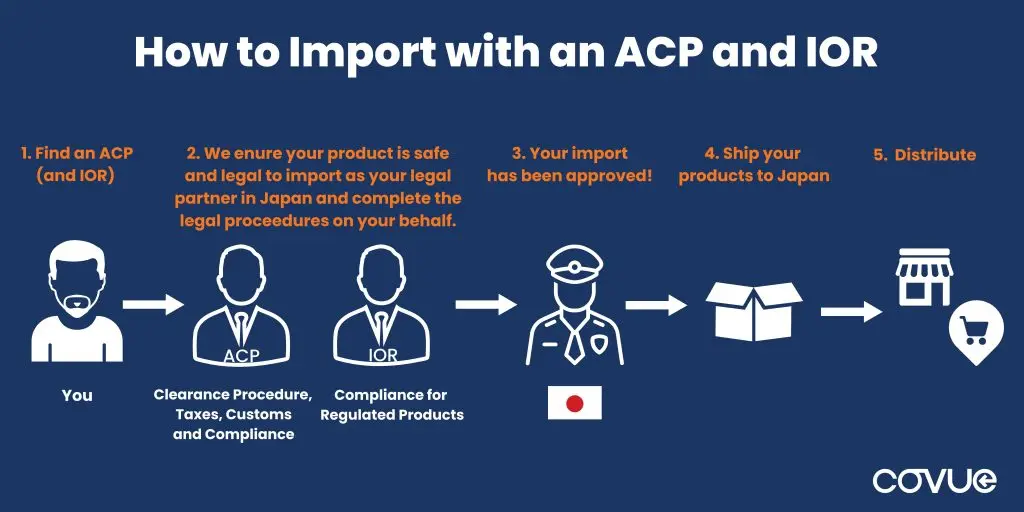
An Attorney of Customs Procedure (ACP) is responsible for facilitating customs clearance procedures, making it a critical point of contact between foreign sellers and Japanese authorities. The role involves ensuring that taxes and customs procedures are handled correctly and in compliance with Japanese regulations.
An Importer of Record (IOR) is required for regulated products in addition to an ACP. This dual requirement helps maintain compliance with Japan’s stringent import and sales regulations, ensuring that your business operates smoothly and legally within the Japanese market.
When selecting an IOR, it is critical to ensure that they possess the necessary licenses for importing, storing, and Sales & Marketing (MAH) for your specific product category, as many IORs focus solely on the importing aspect.
For regulated products such as electronics requiring PSE certification, cosmetics, quasi-drugs, medical devices, food supplements, shelf-stable foods, food apparatus, toys, and products for children under six, both an IOR (Importer of Record) and an ACP (Attorney for Customs Procedure) are required.
Benefits of Engaging ACP/IOR Services
1. Compliance Assurance: With both an ACP and IOR in your corner for regulated products, you can rest assured that your products comply with all local regulations, avoiding costly legal issues and potential fines.
2. Smooth Customs Process: ACPs streamline the customs process by efficiently managing paperwork and clearances, reducing the chances of delays that can affect your supply chain and customer satisfaction.
3. Market Access: Having an ACP/IOR allows you to sell your products in Japan without the need to establish a physical presence in the country, which can be both costly and time-consuming.
Choosing the Right ACP/IOR Partner
Selecting a reputable ACP/IOR provider is a crucial first step to entering the Japanese market. A reliable partner should have:
✅ In-depth Knowledge of Japanese Regulations: Ensure your partner has a deep understanding of Japan’s import and sales regulations, especially for your specific product category.
✅ Proven Track Record: Look for a provider with a strong history of successfully helping foreign businesses enter and thrive in the Japanese market.
✅ Transparent Services: Choose a provider that offers clear, transparent services without hidden fees or complex terms.
✅ Clear Communication: Effective and open communication throughout the import process is key to ensuring a smooth market entry.
✅ Comprehensive Support: The ideal partner should guide you through the entire process, from compliance to customs clearance and beyond, providing end-to-end support.
Appointing an ACP and structuring your importing architecture is not a procedural checkbox. It is the foundation of your entire Japan market entry.
Before shipping inventory, brands must align customs representation, regulatory licensing where required, tax structure, and channel strategy. A poorly designed importer structure can create long-term operational risk and limit future scalability.