What is Trade Compliance and Why Does it Matter?
Trade compliance is not a formality. In Japan, it is a legal and operational obligation that determines whether your goods clear smoothly or stall at the border.
Any company importing into or exporting from Japan operates within a structured framework governed by the Customs Act, the Foreign Exchange and Foreign Trade Act, and product-specific legislation such as the Food Sanitation Act or the PMD Act. These rules define who is legally responsible for declarations, documentation accuracy, licensing, and regulatory conformity.
When compliance is misunderstood or oversimplified, the consequences are immediate. Shipments are delayed. Duties are reassessed. Investigations are triggered. Distributor confidence weakens.
In a market that values procedural precision, trade compliance is foundational to sustainable market access.
Trade Compliance as Legal Responsibility in Japan
In Japan, the entity that submits the import declaration to Customs holds legal responsibility for the accuracy of that declaration. Known as “Importer of Record” in some other jurisdictions, however, in Japan the framework is different. Instead, responsibility is defined through the declarant structure under the Customs Act and, where applicable, through additional licensed roles depending on the product category.
For example:
- Under customs procedures, an entity may appoint an Attorney for Customs Procedures (ACP) to file on its behalf.
- In medical devices and pharmaceuticals, a licensed Marketing Authorization Holder (MAH) is legally responsible for product compliance and post-market obligations.
- For food products, an importer must submit a Food Import Notification and comply with the Food Sanitation Act.
Each of these roles carries defined regulatory accountability. They are not interchangeable and must align with the product category and business structure.
This distinction is critical. Delegating logistics tasks does not eliminate legal responsibility. Companies must understand which entity holds declaration liability and which entity holds product compliance responsibility.
The Core Pillars of Trade Compliance
Trade compliance in Japan spans multiple interconnected disciplines. It is not limited to customs filing. A structured framework typically includes:
Tariff classification
Correct classification under the Harmonized System determines applicable duty rates, statistical reporting, and potential licensing triggers. Misclassification may result in retroactive duty assessments or audit exposure.
Origin determination
Preferential origin under trade agreements can reduce duties, but only when qualification rules are properly documented. Non-preferential origin also affects labeling and trade remedy exposure.
Valuation
Declared customs value must reflect appropriate transaction value methodology in accordance with WTO valuation principles. Undervaluation or inconsistent transfer pricing practices can trigger post-clearance audits.
Licenses and permits
Certain goods require prior approval, registration, or notification before import or export. This includes regulated categories such as medical devices, cosmetics, chemicals, food products, and dual-use technologies.
Export controls and screening
Exports from Japan are subject to control under the Foreign Exchange and Foreign Trade Act. Classification, end-use review, and counterparty screening are mandatory where applicable.
Incoterms alignment
Commercial terms must clearly allocate cost, risk, and customs responsibility. Misalignment between contract terms and declaration structure often leads to confusion and disputes.
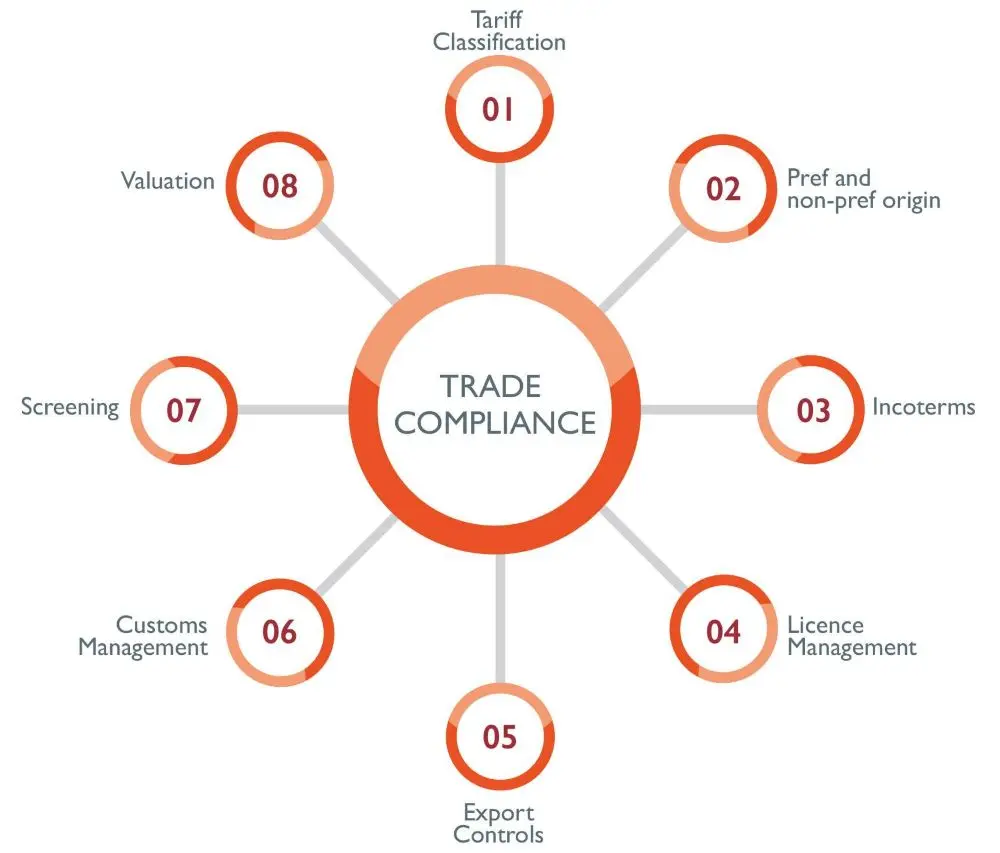
These pillars function together. Weakness in one area creates risk across the supply chain.
Who Must Comply?
All businesses engaged in cross-border trade with Japan are subject to compliance obligations, regardless of size. While industries such as medical devices, electronics, aerospace, and chemicals face heightened regulatory scrutiny, consumer goods companies and ecommerce sellers are equally responsible for accurate declarations and product conformity.
As transaction volume increases, so does audit probability. However, smaller companies are not insulated from enforcement. Japan Customs conducts post-clearance reviews, and regulatory authorities monitor product categories with increasing sophistication.
Compliance expectations scale with operational complexity.
The Cost of Getting It Wrong
Non-compliance rarely begins with dramatic enforcement. It often begins with shipment delays caused by documentation discrepancies or missing approvals. These delays disrupt inventory flow and strain distributor relationships.
Financial exposure follows. Retroactive duty assessments, administrative penalties, and interest charges can accumulate over time. In severe cases involving export controls or sanctions violations, companies may face criminal liability.
Beyond direct penalties, the longer-term cost is loss of credibility. Retailers and distributors expect reliability. Repeated customs issues erode trust and restrict expansion.
Compliance as Competitive Advantage
Trade compliance should not be viewed solely as risk mitigation. When structured properly, it supports margin protection, faster clearance cycles, predictable landed cost calculation, and audit resilience.
For companies entering Japan, compliance architecture should be defined before the first shipment leaves origin. Classification protocols, valuation methodology, licensing verification, and declarant structure must be aligned with commercial strategy.
Japan rewards operational discipline. Businesses that treat compliance as infrastructure rather than paperwork build stronger foundations for sustainable growth.
Compliance in Japan is defined by legal responsibility and procedural precision.
If you are planning to import or export in Japan, your declaration structure, licensing alignment, and customs strategy must be clearly defined before shipment. A structured compliance framework protects your market access and operational stability.
This article was originally posted on June 1, 2021, and updated with recent information on January 6, 2025.